China Golden Triangle: Best for First Time Visitors
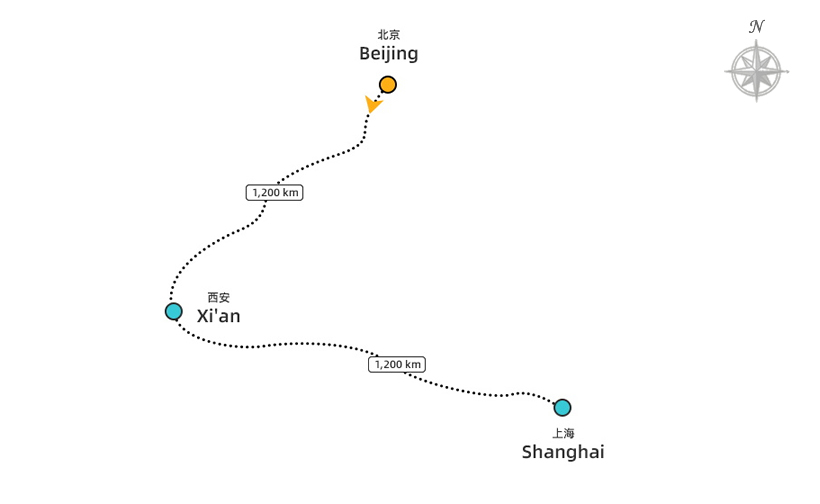
Beijing>Xi'an>Shanghai: Best for first-time visitors to China
Recommended tour length: 8 days
Recommended entry city: Beijing
Recommended departure city: Shanghai
Best time to visit: All year round
Entry city: Beijing
Note: There are two international airports in Beijing: Beijing Capital International Airport (25 kilometres from the centre of Beijing) and Beijing Daxing International Airport (46 kilometres from the centre of Beijing). Both airports have international flights, so pay attention to the airport when purchasing tickets and travelling.
Day 1-3: Beijing
With a history dating back more than 3,000 years, Beijing is one of the four ancient capitals of China. Today it is the capital of modern China and the city with the largest number of UNESCO World Heritage Sites in the world.
Recommended excursions and experiences:
- The Palace Museum (UNESCO World Cultural Heritage, national 5A-level tourist attraction): Constructed from 1406 at the very centre of Beijing, the Palace Museum is more widely known as the Forbidden City. Previously home to 24 different emperors, it is the largest palace complex in the world at approximately 720,000 square metres.
- National Museum of China: This museum houses more than 1.4 million items in its collection, including ancient and modern artefacts, rare and antiquarian books and other works of art. Covering a floor space of nearly 200,000 square metres, it is the largest single-building museum in the world.
- Temple of Heaven (UNESCO World Heritage Site, national 5A-level tourist attraction): Completed in 1420, the Temple of Heaven is the largest complex of sacrificial buildings in China that still stands to this day. The temple was visited by Ming (1368-1644) and Qing (1636-1912) emperors on an annual basis to pray to the heavens for a good harvest. The subtle employment of acoustic principles used in the construction of the Echo Wall, Triple Sound Stone and Dialogue Stone reflects the advanced architectural technology in use in ancient China.
- The Great Wall of China (UNESCO World Heritage Site): The Great Wall is the largest ancient defensive project ever undertaken in China and even the world. Built continuously over 2,000 years starting in the Western Zhou Dynasty (1046-771 BC), the Great Wall now snakes its way across vast areas of northern and central China and has a total length of more than 20,000 km. The wall is a physical illustration of the Chinese philosophy of defending and tolerating rather than expanding and invading.
- The Summer Palace (UNESCO World Cultural Heritage, national 5A-level tourist attraction): This Qing Dynasty (1636-1912) imperial palace and garden is the largest and best-preserved imperial garden in China. Modelled on the West Lake in Hangzhou and borrowing design techniques and artistic ideas from the gardens of Jiangnan south of the Yangtze River, this landscaped park offers the perfect summer retreat.
- The Beijing Hutongs: Originating in the Yuan Dynasty (1271-1368), a hutong refers to a long narrow alley formed by the walls of traditional siheyuan courtyard residences (a building style that represents harmony and reunion). The thousands of hutongs in Beijing have been home to noble families and celebrities, seen the birth of famous restaurants and dishes and spawned incredible legends. Visitors can explore the hutongs on foot or by rickshaw, either of which makes for a pleasant experience. The best neighbourhoods to visit include Shichahai, Dongsi, South Luogu Lane, Dashilan in Qianmen.
- Traditional Peking duck: There is no better place to eat Peking Duck than its home. Restaurants such as Blessing for All Seasons, Dadong, 1949 Whole Duck Season, Quanjude and Bianyifang are all good choices.
Travel from Beijing to Xi'an:
Distance between Beijing and Xi'an: About 1,200 km
High-speed rail: A minimum of 4.5 hours
Plane: 2 hours
Overnight train: 12 hours
Day 4-5: Xi'an
Historically known as Chang’an, Xi’an was the starting point of the ancient Silk Road and was featured in The Travels of Marco Polo by the famous Italian explorer. As a capital of one of the world's four major ancient civilizations, Xi'an can be mentioned in the same breath as cities like Athens, Cairo and Rome.
Recommended excursions and experiences:
- Emperor Qinshihuang's Mausoleum Site Museum (UNESCO World Heritage Site, national 5A-level tourist attraction): Emperor Qinshihuang's Mausoleum Site Museum has been built over the burial site of the world-famous terracotta warriors, which are part of the mausoleum of the first emperor of Qin. Dating back to between 246 and 208 BC, the pits contain more than 8,000 realistic clay figures and horses, each one with unique features. The site was discovered in 1974 and is regarded as one of the greatest archaeological discoveries of the 20th century.
- Shaanxi History Museum (national 4A-level tourist attraction): Shaanxi History Museum contains more than 1.7 million cultural artefacts dating from ancient times to the present day. Among them are a range of pottery tomb figures from successive dynasties, various gold and silver Han (202 BC-220 AD) and Tang Dynasty (618-907) wares that are unique in the country, and a collection of Tang Dynasty tomb murals that are unparalleled globally. The museum is an excellent place to start to understand the arts and culture of ancient China.
- Giant Wild Goose Pagoda (UNESCO World Heritage Site, national 5A-level tourist attraction): The Giant Wild Goose Pagoda, located in Daci'en Temple (also known as Daci'en Temple Pagoda) in the southern suburbs of Xi'an, has a history of more than 1,300 years and is regarded as the symbol of the ancient capital of Xi'an. The pagoda is a master work of Buddhist architecture and a fine example of an ancient pavilion-style brick pagoda.
- Xi'an City Walls (national 5A-level tourist attraction): Located in the centre of Xi'an, the Xi'an City Wall was built in the early Ming Dynasty (1368-1644) over the previously existing palace walls of the Tang Dynasty. It is the best-preserved and largest city wall in China and extends a total of 13.74 kilometres. The wall has a moat, draw bridges, watchtowers, corner towers and other military defences.
Travel from Xi'an to Shanghai:
Distance from Xi'an to Shanghai: About 1,200 km
Flight: 1.5 hours
High-speed rail: A minimum of 4.5 hours
Day 6-8: Shanghai
Located in eastern China at the mouth of the Yangtze River, Shanghai is one of the country’s four municipalities. An important port city, Shanghai has two airports (Pudong International Airport and Hongqiao International Airport) and three major railway stations (Shanghai Railway Station, Shanghai South Railway Station and Shanghai Hongqiao Railway Station)
Recommended excursions and experiences:
- Yu Garden (national 4A-level tourist attraction): Built in the Ming Dynasty (1368-1644), Yu Garden is a classic example of a Jiangnan region garden and the most famous of five classical gardens in Shanghai. The Yu Garden compound consists of more than 30 halls and is divided into six sections by “dragon walls”, tall white walls with undulating grey tiled ridges each terminating in a dragon’s head. Next to the garden is Yuyuan Bazaar, a labyrinth of small streets and lanes where you can find a large number of restaurants, tea houses and shops. The most popular restaurants are NanxiangMantou Restaurant, famous for its xiaolongbao, Lubolang Restaurant and Old Shanghai Restaurant.
- Jade Buddha Temple: Located on An’yuan Road, the Jade Buddha Temple is a Buddhist temple founded in 1882. It is home to two jade Buddha statues imported by sea from Myanmar to Shanghai.
- The Bund: One of the city’s most recognisable landmarks and the pride of Shanghai for over one hundred years, the Bund is a mile-long stretch of waterfront promenade along the Huangpu River. On the west side of the road stand 52 buildings of various architectural styles, including Gothic, baroque, and neoclassical styles. It is often called an outdoor museum of buildings.
- Shanghai Tower: The Shanghai Tower is the tallest building in China. Standing an incredible 632 meters tall, it is one of Shanghai’s major tourist attractions and no visit to the tower would be complete without taking in the view from the Top of Shanghai Observatory on the 118th floor.
- Shanghai Oriental Pearl Tower (national 5A-level tourist attraction): Standing by the bank of the Huangpu River, the Oriental Pearl TV Tower has been an iconic landmark of Shanghai since its completion in 1994. Visitors can enjoy a panoramic view of the Huangpu River as they ascend the 351-meter-high structure in a transparent elevator. An even better option is to enjoy a night-time view of Shanghai while sampling a range of dishes in the 267-meter-high revolving restaurant.
- Nanjing Road: Nanjing Road is about 1,200 meters long and one of Shanghai’s most famous shopping streets. The street has 52 well-preserved old European-style buildings that have been revived as chic restaurants, top-end shops and lively bars. Here you can see the Dangdang sightseeing tram – a miniature version of the old trolley cars that used to shuttle back and forth, giving you a taste of old Shanghai
- Night tour of the Huangpu River: A cruise along the Huangpu River is a different way to see the bustling sights of Shanghai, and it is even more beautiful after sunset, when the lights on both sides of the river start to twinkle.
- Tianzifang: Tianzifang is an artsy area that has developed among the renovated shikumen buildings of Shanghai. Visitors can wander through the web of narrow alleys, look around the boutiques and scope out the latest trends. The area is one of the most popular Shanghai attractions for younger travellers.
- Shanghai Museum: Founded in 1952, the Shanghai Museum has a collection of over one million cultural artefacts including bronzeware, ceramics, calligraphy and painting. Of these, more than 140,000 items are designated precious relics.
- InterContinental Shanghai Wonderland: This is the lowest altitude luxury hotel in the world at 88 meters below the horizon. Located in an old quarry in Songjiang, the hotel consists of two above-ground floors, 15 underground floors and two underwater floors. InterContinental Shanghai Wonderland is a result of true architectural innovation and engineering breakthroughs.
City of departure: Shanghai
Notes:
- Shanghai has two international airports: Shanghai Hongqiao International Airport and Shanghai Pudong International Airport.
- The distance from Shanghai to Beijing is about 1,200 kilometres. For outbound travellers from Beijing, we recommend flying from Shanghai to Beijing (2.5 hours) or taking the high-speed train (at least 4.5 hours).
New ways to play:
New ways to play in Beijing
- One-day walk on the Jinshanling Great Wall (Beijing) Jinshanling Great Wall (UNESCO World Heritage Site, national 5A-level tourist attraction) is located in Chengde City, Hebei Province, 130 kilometres away from the centre of Beijing. The magnificent Jinshanling Great Wall offers incredible views and is suitable for hiking and photography in all seasons. Standing at the top, hikers can enjoy a panoramic vista of the wall.
- Cultural and artistic experiences In Beijing, visitors can experience China’s intangible cultural heritage by taking part in activities related to traditional Chinese medicine, tea culture, tai chi, cloisonné, folding fans and painted sculptures.
- National Centre for the Performing Arts: Located to the west of Tiananmen Square and designed by French architect Paul Andreu, the National Centre for the Performing Arts is the largest theatre complex in Asia. The super ellipsoid-shaped building ‘floats’ on an artificial lake in an interplay of tradition and modernity, romance and reality. A prestigious place for the performing arts in China, the venue hosts opera, concerts, dance, drama and other performances.
- CAFA Art Museum: An affiliate to the Central Academy of Fine Arts (founded more than 100 years ago), CAFA Art Museum relocated to its present location in 2008. The museum building was designed by the famed Japanese architect Arata Isozaki and represents his first art gallery in China.
- 798 Art District: The home of Beijing’s cultural and creative communities, this district was originally a radio equipment factory built and designed by the former East Germany in the 1950s with aid from the Soviet Union. Artists and galleries started settling in the area in 2002, and since then it has developed into a fully-fledged artistic community. This is the perfect place to check out and even purchase contemporary Chinese culture and art.
New ways to play in Xi'an
- Day trip from Xi'an to Luoyang by high-speed rail (1.5 hours) Longmen Grottoes (UNESCO World Heritage Site,national 5A-level tourist attraction): The Longmen Grottoes were developed over 400 years starting in 493 AD. Spread along a one-kilometre stretch of cliff running from north to south, there are over 2,300 grottoes containing as many as 100,000 statues and 2,800 inscriptions. The largest Buddha statue in the Longmen Grottoes, Losana Buddha, is 17.14 meters high and has a 4-metre-high head and ears that are 1.9 meters long. The Longmen Grottoes are one of the three most famous grottoes in China, alongside the Dunhuang Mogao Grottoes and Datong Yungang Grottoes. White Horse Temple (national 4A-level tourist attraction): Founded in 68 AD, White Horse Temple was the first government-run temple built after the introduction of Buddhism to China and has a history of more than 1,900 years.
- Day trip to Mount Hua (national 5A-level tourist attraction): Mount Hua is 120 kilometres east of Xi'an, a trip of about 1.5 hours by car. At a maximum altitude of 2,154 metres, the imposing mountain is known for its sheer cliffs and dizzying mountain paths. It is also a sacred mountain in the Taoist faith.
- Tang Paradise (Xi'an): Tang Paradise is modelled on the imperial gardens of the Tang Dynasty (618-907AD). China’s first large-scale imperial garden-based cultural theme park, it aims to illustrate the incredible prosperity of the Tang Dynasty.
- Terracotta warrior-making at the Emperor Qinshihuang's Mausoleum Site Museum: Find out how terracotta warriors are made. During the session, you’ll learn about the craftsmanship involved in producing terracotta warriors, the artistic features of the many thousands of faces, and how to match colours. Next, you can have a go at creating terracotta warriors and horses with clay yourself.
- Xi'an City Wall bike tour: Each of the four gates of the Xi’an city wall have bike rental shops where you can rent bikes and tandems for adults and children. The walls are about 14 kilometres long and it takes approximately 2-3 hours to follow their route around the city.
New ways to play in Shanghai
1-2 day trip to Suzhou
With only 110 kilometres separating Shanghai and Suzhou, visitors can hop between the two in 2 hours by bus or 30 minutes by high-speed train.
- Suzhou Gardens (UNESCO World Heritage Site): There are three types of Chinese gardens – imperial gardens, temple gardens and private gardens – and Suzhou’s gardens are representative of the latter type. Reputed as "heaven on earth" since ancient times, Suzhou boasts beautiful natural scenery, a well-developed economy and a thriving cultural life. In 1997 and 2000, nine of Suzhou’s classical gardens, including the Humble Administrator's Garden, Lingering Garden, Lion Grove Garden and the Master of the Nets Garden, were added to UNESCO's World Heritage List.
- Suzhou Museum: Suzhou Museum was designed by the world-renowned architect I. M. Pei (who designed the glittering glass pyramid at the entrance to the Louvre in France). The Suzhou Museum takes an elegant form that blends in well to its surroundings and the open-plan glass and steel frame structure maximizes natural light. Suzhou Museum has a collection of nearly 40,000 cultural artefacts, allowing visitors to gain a deeper understanding of Chinese culture and art through traditional Chinese calligraphy, paintings, fine objects and Buddhist relics.
1-2 day trip to Hangzhou
Hangzhou is about 2.5 hours away from Shanghai by car or an hour by high-speed train.
The capital city of Zhejiang province, Hangzhou is located at the southern end of the Beijing-Hangzhou Grand Canal (a UNESCO World Heritage Site) and is rated as one of the best cities in China to visit.
- The West Lake (UNESCO World Heritage Site, national 5A-level tourist attraction): Hangzhou’s beauty has been eulogized in China since ancient times, and during the Yuan Dynasty (1271-1368), Marco Polo, the famous Italian traveller, praised Hangzhou as "the most splendid heavenly city in the world". The essence of Hangzhou's beauty lies in its West Lake. Surrounded by hills on three sides, West Lake is China's only lake to be listed on UNESCO’s World Heritage List. There are ten attractions and as many as twenty museums around West Lake.
- Archaeological Ruins of Liangzhu City (UNESCO World Heritage Site) & Hangzhou Liangzhu Culture Museum: The Liangzhu culture dates back to between 4,300 to 5,300 years ago and the vast site of the Liangzhu city ruins is one of the most complete Neolithicarchaeological sites in China. The city’s ruins serve as an important example of city planning and architectural design in the early stages of human civilization. The elegant black pottery, beautiful fabrics, exquisite jade, gorgeous lacquer and well-developed bamboo wares displayed in the Liangzhu Cultural Museum give visitors an understanding of the creativity and culture of the Liangzhu people.
- Hangzhou Handicraft Exhibition Hall: In 2012, Hangzhou was listed as a Capital of Crafts and Folk Art by UNESCO. In the Hangzhou Handicraft Exhibition Hall, you can learn about more than twenty traditional intangible cultural heritage crafts such as paper cutting, bamboo weaving and egg carving.
- Chinese Fan Museum: At the Chinese Fan Museum, you can see a wide range of finely-made fans created out of materials like ivory, sandalwood, silk and tortoiseshell. The museum covers 68 fan-making processes and features fans produced by Wang Xingji, a famous Hangzhou fan-maker established in 1875. You can also participate in fan-making activities so you can leave the museum with a unique fan of your own.