North China Ancient Cities and Shaolin Kungfu Experience
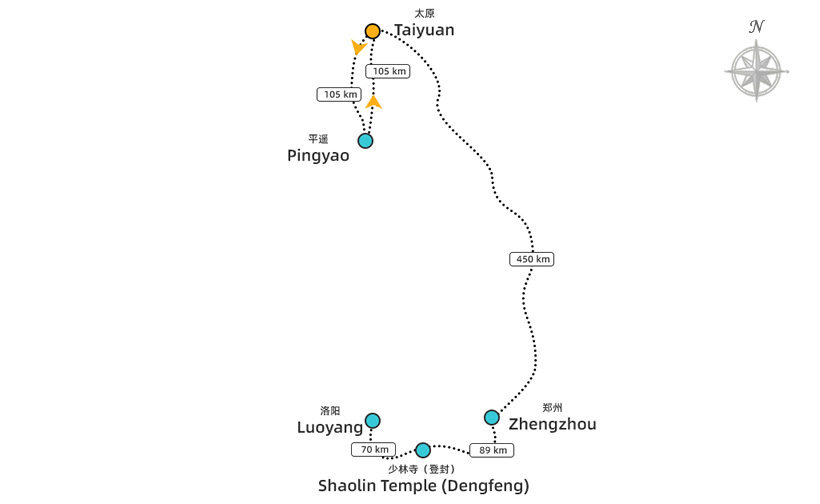
Taiyuan-Pingyao-Zhengzhou-Shaolin Temple-Luoyang
Recommended tour length: 8 days
Recommended entry city:: Beijing
Recommended departure city: Beijing or Shanghai
Best time to visit: April to November
Day 1 Taiyuan
Taiyuan is the provincial capital of Shanxi. Located in the central region of China, it has 2,500 years of history. Combining natural landscapes with historical relics, this city served as a key political, military, economic, and cultural center in ancient northern China.
Recommended excursions and experiences:
Jinci Temple (national 4A-level tourist attraction)
Located 25 kilometers from Taiyuan city center, Jinci Temple is a cultural site that combines ancient Chinese ancestral halls, gardens, sculptures, murals, and stone carvings. Built in 386, this complex contains over a hundred ancient temples, a hundred sculptures, 400 steles, and 20 thousand-year old trees, along with several rare cultural artefacts.
Website: https://www.chinajinci.com/p/English
Shanxi Museum
Shanxi Museum is a national first-grade museum with a history of 101 years. It currently holds more than 500,000 artefacts, mainly including bronzeware, ceramics, stone carvings, Buddha sculptures, murals, and calligraphy.
Website: http://en.shanximuseum.com/sx/index/index.html
Days 2-3 Pingyao
Distance from Taiyuan to Pingyao: Approx. 105 kilometers
Transportation: Bus (approx. 1.5 hours)/high-speed train (approx. 30 minutes)
Recommended excursions and experiences:
Pingyao Ancient City (World Cultural Heritage, national 5A-level tourist attraction)
With a history of more than 2,700 years, Pingyao is the most intact ancient city in China.
According to UNESCO: “The Ancient City of Ping Yao is an outstanding example of Han cities in the Ming and Qing dynasties (from the 14th to 20th century). It retains all the Han city features, provides a complete picture of the cultural, social, economic and religious development in Chinese history, and it is of great value for studying the social form, economic structure, military defense, religious belief, traditional thinking, traditional ethics and dwelling form.”
Recommended sightseeing spots in the ancient city: Ming-Qing Street, Confucian Temple, Rishengchang Former Bank (one of China’s earliest exchange shops), County Government, Qingxu Temple, City Wall
Qiao Family Courtyard
This outstanding example of Shanxi's ancient residential architecture is located approximately 40 kilometers from the Pingyao Ancient City. Since Zhang Yimou's movie "Hanging the Red Lantern" was filmed in this location, it has become famous at home and abroad. There is a saying in northern China: "The imperial family has the Forbidden City, and private houses look to the Qiao family house". As a well-known wealthy business family in Shanxi, the Qiao family designed their house in an exquisite manner. From the top, the house resembles the Chinese character "囍" shape viewing from the top which means happiness in English. The successive layers of the house demonstrate the refinement of traditional customs. Amazing sculptures can be seen all around the Qiao Family Courtyard. The vivid images and superb craftsmanship on display reflect knowledge and wealth of the Qiao family.
Wang Family Courtyard (national 4A-level tourist attraction)
This Major Historical and Cultural Site Protected at the National Level, located approximately 52 kilometers away from the ancient city of Pingyao, is known as the Forbidden City of Shanxi. The Wang Family Courtyard is a masterpiece of Qing Dynasty (1644-1911) residential architecture which took more than 300 years to build. Including Five Lanes and Six Forts, it covers a total area of 250,000 square meters. The architectural details here are gorgeous, and the brick, wood, and stone carvings (known as the “three carvings”) display rich themes and skilled techniques. For this reason, the Wang Family Courtyard resembles a traditional architectural art museum.
Travel for Pingyao-Taiyuan-Zhengzhou:
Distance from Pingyao to Taiyuan: Approx. 105 kilometers
Transportation: Bus (approx.1.5 hours)/high-speed rail (approx. 30 minutes)
Distance from Taiyuan to Zhengzhou: Approx. 450 kilometers
Transportation: High-speed rail (approx. 3 hours)
Day 4 Zhengzhou
Zhengzhou is the provincial capital of Henan, and an important central city and transportation hub in central China. It has a reputation for being the “crossroads of Chinese transportation”. Zhengzhou is a key birthplace of Chinese civilization, and is therefore home to numerous cultural relics.
Recommended excursions and experiences:
Henan Museum
Founded in 1927, Henan Museum is one of the earliest museums in China, with more than 170,000 sets of cultural relics. These mainly include prehistoric relics, bronzeware, and ceramics, jade, and stone carvings. This house of cultural and artistic treasure testifies to the development of Chinese civilization and the development of China throughout history.
Website: http://english.chnmus.net/
Day 5 Shaolin Temple (Dengfeng)
Distance from Zhengzhou to Shaolin Temple (Dengfeng): Approx. 89 kilometers
Transportation: Bus (approx. 1.5 hours)
Recommended excursions and experiences:
Shaolin Temple (World Cultural Heritage, national 5A-level tourist attraction)
This site is a birthplace of Chinese Zen Buddhism and Chinese Kung Fu. Built in 495 AD, Shaolin Temple is an ancestral Zen monastery. It occupies an important position in the history of Chinese Buddhism and is honored as the "No. 1 Temple under Heaven" in China. Due to the painstaking research on past generations of Shaolin monks and constant development of Shaolin kungfu that have taken place here, this spot is world famous. It has been recognized as the origin of Zen Buddhism and the cradle of Chinese kungfu.
Website: http://www.shaolin.org.cn/eng_index.html
Travel from Shaolin Temple (Dengfeng) to Luoyang:
Distance from Shaolin Temple (Dengfeng) to Luoyang distance: Approx. 70 kilometers
Transportation: Bus (approx. 1 hour)
Day 6-8 Luoyang
With a history of over 5,000 years of civilization and 1,500 years of capital settlement, Luoyang is an ideal place for visitors to visit famous tourist attractions during the day and enjoy the night view of the ancient city at night. Peonies bloom all over the city every April.
Recommended excursions and experiences:
Longmen Grottoes (World Cultural Heritage, national 5A-level tourist attraction)
The Longmen Grottoes were excavated in 493 AD. Following 400 years of construction, they stretch a distance of 1 km from north to south, with more than 2,300 cave niches, 100,000 statues, and 2,800 inscriptions. The largest Buddha statue in the Longmen Grottoes is the Lucena Buddha, which stands at 17.14 meters, with a head height of 4 meters, and an ear length of 1.9 meters. Together, the Longmen Grottoes, Dunhuang Mogao Grottoes, and Datong Yungang Grottoes form the three “treasure houses” of cave art in China.
White Horse Temple (national 4A-level tourist attraction)
Founded in AD 68, this is the first government-run temple built after Buddhism was introduced to China. It is more than 1,900 years old
The Tianzi Jialiu Museum
The Tianzi Jialiu Museum is built upon on the original site of the huge “Emperor’s Chariot Drawn by Six Horses” burial pit. According to the ancient Chinese ritual system, only the “Emperor” can ride a six-horse drawn cart. The carts and horse pits are large, with several types of magnificent, neatly-arranged carts, creating a grand atmosphere. This is considered a major archeological discovery of the 21st century.
Wangcheng Park
Built in 1955, Wangcheng Park is so named as it was built on the site of the capital city of the Eastern Zhou Dynasty. It is the largest comprehensive park in Luoyang City. During the Peony Festival at the turn of spring and summer each year, Wangcheng Park is the best place to admire flowers in the ancient Luoyang city.
Luoyang Museum
Founded in 1958, Luoyang Museum was among the first batch of national first-grade museums and is a cultural landmark of Luoyang City. Its collection hold more than 400,000 cultural relics, with over 11,000 on display. It is especially well-known for its bronze ceremonial vessels from the Xia, Shang and Zhou Dynasties, pottery figurines from the Han and Tang Dynasties, Sancai (three color porcelain) from the Tang Dynasty and porcelain from the Song Dynasty. Moreover, the bronze nobles from the Xia Dynasty, gold, silver, and bronze tripods from the Warring States period, pottery sculptures from the Northern Wei Dynasty, and three-color lanterns/horses from the Tang Dynasty are regarded as national treasures.
New ways to play
The following tours can be added to your trip
New ways to play in Taiyuan
Tianlong Mountain Grottoes: 40 kilometers away from Taiyuan City, distributed among the cliff waists of the east and west peaks of Tianlong Mountain, is a model of ancient Chinese sculpture art. In these 24 excavated caves from the 6th to 10th centuries, there are more than 1,500 grotto statues, and 1,144 reliefs, algae wells, and portraits. The Tianlongshan Grottoes provide rich materials for future generations to study Buddhism, fine arts, sculpture, and architecture with their skillful shapes, soft lines, and fine carvings. They occupy an extremely important position in the global history of sculpture art.
New ways to play in Zhengzhou
- Day tour of Gongyi Grottoes Temple and Kangbaiwan Manor (approx. 1.5 hour drive from Zhengzhou)
Gongyi Grottoes Temple: Built in 517 AD, this key Buddhist grotto is located in the Central Plains of China. There are 5 existing caves, 1 thousand-Buddha niche, 3 large cliff statues, and 7743 Buddha statues. The grotto sculptures here are meticulously carved, natural, vivid, and otherworldly. In particular, the "Emperor and Empress Ceremony to Buddha" in the first cave displays a perfect composition and magnificent scene. It is a masterpiece of stone carving art from the Northern Wei Dynasty (386-534). The national treasures and incredible artworks on show here are breathtaking. - Kangbaiwan Manor (national 4A-level tourist attraction): Built in the middle of the 17th century, this typical feudal fortress building is a Major Historical and Cultural Site Protected at the National Level. The Kang family lived in this manor for 12 generations. This manor, the Qiao Family Courtyard in Jinzhong, Shanxi and the Ma Family Manor in Anyang, Henan, are collectively known as the "Three Official Residences of the Central Plains", which are all models of ancient construction in the Central Plains. The whole manor is composed of 19 parts, covering a huge area, and its architecture and carving features are very much worth seeing.