Discovering Southwest China: Ethnical Culture and Karst Scenery
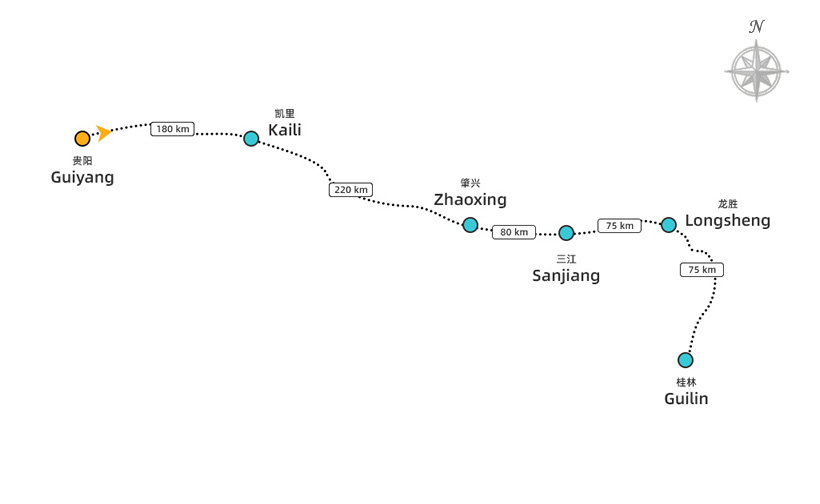
Guiyang > Kaili > Zhaoxing > Sanjiang > Longsheng > Guilin
Recommended tour length: 8 days
Recommended entry cities: Guangzhou, Hong Kong
Recommended departure cities: Guangzhou, Hong Kong
Best time to visit: April to November
Day 1-2: Guiyang
The mountain capital of Guizhou Province, Guiyang was the first city in China to be designated a national forest city. Guiyang's climate is often mild, neither extremely hot nor bitterly cold. It once topped the list of China's top ten summer resort cities.
Recommended excursions and experiences:
Guizhou Provincial Museum
Located in the centre of Guiyang, this museum is an excellent place to get an insight into the history and culture of Guizhou Province. The exhibitions display a large number of precious cultural artefacts, including human fossils dating back to the Palaeolithic age, master works from the Yelang bronze culture, and a lacquer "ear cup" excavated from a Han Dynasty tomb in western Guizhou. Another highlight is the exhibition of artefacts representing the area's ethnic minorities, with the museum playing host to the largest collection of Miao costumes and jewellery in the country.
Official website: http://www.gzmuseum.com/en/
Geological Museum of Guizhou
The Geological Museum houses more than 100,000 items in its collection, including paleontological fossils, minerals, crystals, and ore specimens. The museum reflects Guizhou's important place in palaeontology and the study of sedimentary rocks and karst landforms.
Jiaxiu Pavilion
The Jiaxiu Pavilion is the city's most iconic landmark and a must-see attraction for visitors to Guiyang. Initially built in the Ming Dynasty (1368-1644), this magnificent tower looks especially beautiful at night, and provides great views of the city for those who climb to the top.
Erqi Road Snack Street
Close to Guiyang Railway Station, Erqi Road Snack Street has a high roof above to facilitate feasting no matter the weather. This market is the place to go to try the best of Guizhou's gastronomy.
Qingyan Ancient Town (national 5A-level tourist attraction)
Qingyan Ancient Town lies in the southern suburbs of Guiyang. The settlement was founded in the Ming Dynasty (1368-1644) and used to be a military fortress. The architecture of the Ming and Qing dynasties (1368-1911) is well preserved here, allowing visitors to admire the exquisite stone and wooden carvings of the period.
Travel between Guiyang and Kaili:
Distance: 180 kilometres
Time: About 34 minutes by high-speed train and 2.5 hours by bus
Day 3: Kaili
Located in eastern Guizhou, Kaili is the capital of Qiandongnan Miao and Dong Autonomous Prefecture. The area around the city is home to 33 minority groups, of which the Miao is the largest. The local villages are the ideal place to learn about the culture and customs of the Miao people.
Xijiang Qianhu Miao Village (national 4A-level tourist attraction)
Xijiang Qianhu Miao Village is about 43 kilometres away from the centre of Kaili. The largest Miao settlement in China, the area is made up of about ten well-preserved hillside Miao villages that are even prettier when lit up by lanterns at night. While roaming the twisting lanes between wooden stilt houses, visitors can get a taste for the lifestyles and customs of the Miao people, as well as the stunning scenery. If arriving during a festival, visitors will also get the chance to taste the traditional "long table banquet". If not, there will still be plenty of spicy-sour Miao foods on offer.
Langde Miao Village
Located 29 kilometres outside of the centre of Kaili, Langde Miao Village has about a hundred households and is known as the home of Chinese folk song and dance. Miao people are often split into various subgroups depending on their dialect, dress, location, and other customs. In Langde Miao village, the custom is to wear long skirts, so the local group are called the "Long Skirt Miao".
Shiqiao Miao Village: Thirty-five kilometres from the centre of Kaili, Shiqiao Miao Village is famous for its ancient papermaking culture, which has been listed as a national intangible cultural heritage. Visitors to the village can learn about the papermaking process and witness the ancient craft being handed down from generation to generation.
Xiasi Ancient Town:
Xiasi Ancient Town has a history of more than 600 years and is about 20 kilometres away from Kaili. The population here is mostly made up of ethnic minorities such as the Miao, Mulao, and She. The buildings blend elements of various architectural styles, including Jiangnan courtyards, Hui architecture, southern Fujian architecture, and Miao and Dong architecture.
Travel between Kaili and Zhaoxing:
Distance: 220 kilometres
Time: About 3 hours by bus
Day 4: Zhaoxing
Zhaoxing Town is located in Qiandongnan Miao and Dong Autonomous Prefecture. The Zhaoxing Dong Village is one of the largest Dong ethnicity villages in China.
Zhaoxing Dong Village (national 4A-level tourist attraction):
Zhaoxing Dong Village is renowned for its traditional Dong drum towers and bridges. It is a picturesque village with beautiful natural scenery and unique ethnic customs. The village was voted one of the 33 most attractive tourist destinations in the world by Fashion Travel and National Geographic in 2007. The century-old drum towers and traditional Dong songs are highlights.
Travel between Zhaoxing in Guizhou and Sanjiang in Guangxi:
Distance: 80 kilometres
Time: About 20 minutes by bullet train and 1.5 hours by bus
Day 5: Sanjiang
Located in the north of Guangxi Province, Sanjiang Dong Autonomous County is 167 kilometres away from Guilin. The county boasts the largest, best-preserved, and densest cluster of wooden Dong buildings in China.
Sanjiang Drum Tower
Sanjiang Drum Tower is one of Sanjiang's landmarks. The entire tower structure is joined together using redwood, without a single nail. The viewing platform at the top of the tower provides fantastic views of the surrounding scenery.
Chengyang Eight Villages
This scenic spot is made up of eight Dong villages and is a great choice for sightseeing, photography and experiencing the Dong way of life. The Chengyang Wind-and-Rain Bridge, ancient waterwheels, stilt houses, numerous drum towers and Dong performances all make this an unforgettable place to visit.
Website: http://www.sjcybz.com/en/
Travel between Sanjiang and Longsheng:
Distance: 75 kilometres
Time: About 1 hour and 15 minutes by bus
Day 6: Longsheng
Located 80 kilometres from Guilin, Longsheng offers both nature and culture. It has the highest concentration of ethnic minorities in northern Guangxi and features stunning rice terraces that circle the hills like huge spiral shells.
Jinkeng Rice Terraces
Jinkeng (which literally means "golden crater" and refers to its rich deposits of gold) covers an area of more than 10 square kilometres and is home to the Red Yao (a branch of the Yao ethnic minority). Here, the rice terraces coil round from the hills from top to bottom, creating a beautiful, open landscape that is especially pretty when seen from an elevated viewing spot during sunrise and sunset.
Longji Rice Terraces
The rice terraces in Longji resemble scales on the backs of huge dragons (longji means "dragon's backbone"), fans of hiking or photography will find plenty to enjoy here. Some lucky visitors may arrive during the annual Clothes Drying Festival held by the local Yao people, in which each household hangs their red clothes outside their windows on a string to dry in the sun. The colourful clothes symbolize good fortune for the Yao people.
Travel between Longsheng and Guilin:
Distance: 75 kilometres
Time: About 1 hour
Day 7-8: Guilin
"East or west, Guilin's landscape is best!" Located in the northeast of Guangxi Zhuang Autonomous Region in south China, Guilin epitomises natural rural beauty in China. The region is also home to south China's distinctive karst landscapes.
Li River Scenic Area (national 5A-level tourist attraction) `
The renowned Li River was once called one of "the world's top 10 watery wonders" by the National Geographic. The Li River cruise from Guilin to Yangshuo boasts some of the most spectacular scenery in the region. Along the river you can see Nine Horses Fresco Hill, a large and steep stone cliff which looks like a huge painted screen with images of nine horses in various poses. Another highlight is Yellow Cloth Shoal, a photo of which is printed on China's 20-yuan note. The sight is so named because of a large beige flagstone under the water's surface that resembles a piece of yellow cloth laid flat on the riverbed.
Yangshuo West Street
West Street is the oldest street in Yangshuo and has a history of more than 1,400 years. This incredibly lively street has become a window to eastern and western culture since the 1980's and is full of bars, cafes, restaurants, and shops. Because foreign visitors outnumber Chinese visitors at times and many places have English signs, locals also call it "foreigner street".
Elephant Hill Scenic Area (national 5A-level tourist attraction)
Elephant Trunk Hill is a Guilin landmark and looks like a giant elephant drinking water from the river. Representative of Guilin's landscape and symbolic of Guilin city, it is the central pattern on Guilin's city emblem
Reed Flute Cave (national 4A-level tourist attraction)
Named after the verdant reeds that grow outside and can be used to make flutes, Reed Flute Cave is a spectacular world of stalactites, stone pillars, and rock formations. Illuminated by coloured lights, the cave is a magical place for an underground tour
New ways to play
New ways to play in Guiyang
- Day tour to Huangguoshu Waterfall National Park and Dragon Palace Cave Scenic Spot in Anshun
- Huangguoshu Waterfall National Park (national 5A-level tourist attraction): About 145 kilometres southwest of Guiyang, Huangguoshu Waterfall National Park is named after the Huangguo tree, a local species of fruit tree. The Park contains 18 unique waterfalls along a 20-kilometer stretch of river. The eponymous Huangguoshu Waterfall is the most famous and the largest waterfall in Asia. It was once rated as one of the most beautiful places in China by Chinese National Geography magazine.
Website:https://www.hgscn.com/English/ - Dragon Palace Cave Scenic Spot (national 5A-level tourist attraction): Dragon Palace Cave Scenic Spot is 116 kilometres away from Guiyang and next to the Huangguoshu Waterfall National Park. The Park is built around a huge karst cave network and features a variety of karst landscapes including caves, canyons, waterfalls, cliffs, streams, stone forests, and underground rivers. According to the Chinese Atomic Energy Authority, this area has the lowest natural radiation dose rate in the world.
- Activities nearby Guiyang:Kayaking, caving, scuba diving
New Ways to Play in Kaili, Longsheng and Guilin
- Day tour to Zhenyuan Ancient Town (national 5A-level tourist attraction): About 1.5 hours by train or bus from Kaili, Zhenyuan Ancient Town is the oldest town on the Yunnan-Guizhou Plateau and has a history of more than 2,200 years. Home to many historical artefacts, the town has been named one of the ten most beautiful ancient towns in China thanks to its stunning mountain and river scenery. Wuyang River, the town's "mother river", curls around Zhenyuan in an S shape like a Taoist bagua, giving rise to its nickname, Bagua Ancient Town.
- Day Tour to Longsheng Hot Spring (national 4A-level tourist attraction): Longsheng Hot Spring is 32 kilometres and about 40 minutes' drive from the Longsheng county seat. The spring waters here rise up from over 1,200 meters underground at a temperature between 45°C and 58°C. The waters contain various elements that are beneficial to one's health, including zinc, manganese, lithium, strontium, and iron. Bathing in these springs is said to help alleviate various ailments such as heart disease, rheumatism, and certain skin diseases.
- Silver Cave (national 4A-level tourist attraction): Silver Cave is about 85 kilometres south of Guilin and 3 kilometres from border of Yangshuo. The largest karst cave in Guilin, this attraction reveals the wonder of the natural world and is a great place to experience the majestic and fantastical karst landforms of south China.
- Impression Sanjie Liu show (Yangshuo, Guilin): Directed by celebrated Chinese director Zhang Yimou, Impression Sanjie Liu is an outdoor performance set among the picturesque mountains and rivers of Yangshuo County. Inspired by the legend of Sanjie Liu, a fairy singer of the Zhuang ethnic minority in Guangxi, the show is a sensory feast of music and light, song, and dance. Painting upon the natural scenery using the compositional approaches and techniques of Chinese painting, the show depicts the daily lives of the local fishermen and the ethnic groups that call the river home.
- Night Boat Tour of Two Rivers and Four Lakes Scenic Spot (Guilin): The Two Rivers and Four Lakes Scenic Spot is made up of the natural landscapes within the city of Guilin, which includes the Li River, Taohua River, Mulong Lake, Guihu Lake, Ronghu Lake and Shanhu Lake. The 1.5-hour night cruise offers visitors a chance to see Guilin’s tranquil mountain and water scenery from the best possible vantage point: the water itself.
- Local dishes: Fish in sour soup, siwawa (vegetarian spring rolls), Yangshuo beer fish, Guilin rice noodles