Exploring Yunnan: The Search for Shangri-la
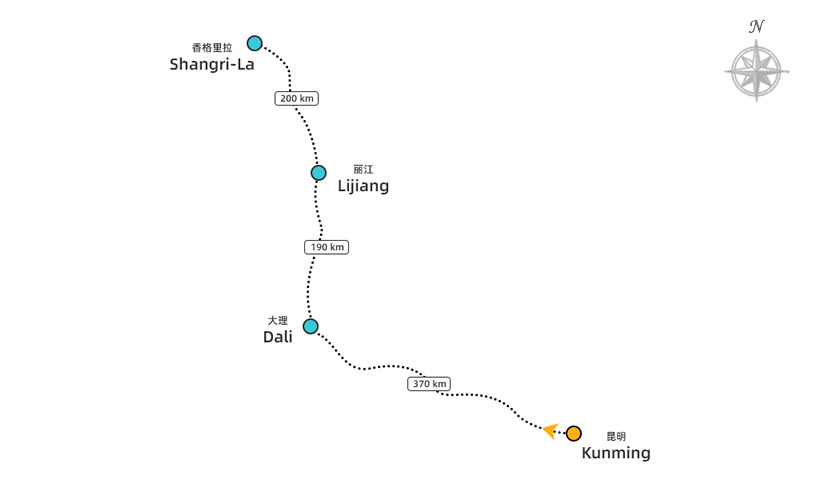
Kunming > Dali > Lijiang > Shangri-La
Recommended tour length: 7 days
Recommended entry city: Kunming
Recommended departure city: Kunming
Best time to visit: April to November
Day 1: Kunming
Kunming is the capital of Yunnan Province. It is a “city of eternal spring” where flowers bloom all the year round, making it a great place for recreation, tourism, holidays and even long-term stays.
Recommended excursions and experiences
- Stone Forest Scenic Area (World Heritage Site, national 5A-level tourist attraction) Located in Shilin Yi autonomous county about 70km from Kunming, the Stone Forest Scenic Area is famous for its karst landforms – various types of oddly-shaped rocks that seem to take on the feel of a huge forest that boggles the mind and sparks the imagination. The area has the largest number of karst formations in the world and is a marvel to behold.
- Lake Dian:Lake Dian is the largest freshwater lake in Yunnan. At an elevation of 1,885 meters, the stunning lake is praised locally as the “pearl of the plateau”. Lake Dian Resort is designated a national-level resort and is the only one located in an inland province. Around the lake are a number of interesting tourist attractions, such as Kunming West Hill Forest Park, Guanyin Mountain, Daguan Park and Yunnan Nationalities Village. Visitors can also tour the lake in a leisure boat to enjoy the scenery from the water
Transport between Kunming and Dali:
Distance: 370 kilometres Time:1 hour by flight and about 2 hours by high-speed train
Day 2-3 Dali
Dali is a historical city, scenic area and nature reserve all rolled into one. With a pleasant climate and lots of sunshine, the Dali area is replete with rivers, lakes and forests, all capped by a blue sky laced with white clouds.
- The Three Pagodas of Chongsheng Temple, Dali (national 5A-level tourist attraction):The Three Pagodas of Chongsheng Temple is a famous Buddhist temple about 1.5 kilometres to the north of Dali Old Town, west of Erhai Lake and east of Cangshan Mountain. Once the imperial temple of the Dali Kingdom (937-1253 AD), it retains its magnificence to this day.
- Dali Old Town (national 4A-level tourist attraction):Dali Old Town dates back to 1382 and is one of the most highly-rated historical cities in China. Sandwiched between the Cangshan Mountain and Erhai Lake, the town feels distinctive both architecturally and culturally due to the presence of the Bai people. The green flagstone streets are lined with earth-and-wood construction houses with grey-green tiled roofs, many of which date back to the Qing Dynasty and later Republican period. The town is dotted with workshops, temples, schools and churches, as well as shops selling Dali marble and tie-dyed handicrafts. The east-west Huguo Road is known as "foreigner street", with the Chinese and western restaurants, cafes, tea houses and gift shops here all writing their signs in English as well as Chinese.
- Erhai Lake:Erhai Lake just outside of Dali town is the second largest freshwater lake in Yunnan Province. The lake sits at an altitude of 1,972 meters and has a surface of 251 square kilometres. The lake’s name literally means “a sea shaped like an ear” after its shape and size. The scenery of Erhai Lake is truly gorgeous, and especially so when appreciated from atop its clear blue waters.
- Xizhou Ancient Town:Eighteen kilometres north of Dali Old Town is Xizhou Ancient Town, which is primarily home to people of the Bai minority. Xizhou is a great place to learn about the culture and architecture of the Bai as so many buildings are well preserved. In the town, Sifang Street and the banyan tree are not to be missed.
- Local dishes: Dali casserole fish, ersi noodles (sliced rice cake with pork and vegetables), Dali three course tea
Travel between Dali and Lijiang
Distance: 190 kilometres Time: 2.5 hours by car and about 1.5 hours by high-speed train
Day 4-5: Lijiang
Located in the north-western plateau of Yunnan Province, Lijiang is a nationally-famous historical and cultural town and the first ancient town in China to be listed on UNESCO’s World Heritage List. The town also has an interesting history as a stopping-off point on the ancient Tea Horse Road, also known as the Southern Silk Road.
- Lijiang Ancient Town (UNESCO World Heritage Site, national 5A-level tourist attraction):Lijiang Ancient Town has a history of over 800 years and is also known as Dayan. A commercial, political and cultural centre of the Naxi people, is said to be the only old city in China that was built without a city wall. Lijiang Ancient Town was also a strategic stop-off point for merchants carrying goods on the ancient Tea Horse Road, a series of caravan routes that snake across south-western China. The town is a maze of wooden houses with grey tiles roofs, old streets, flagstone-paved lanes, tiny bridges and flowing streams. From East Avenue, visitors can look up and see Jade Dragon Snow Mountain in the distance.
- Jade Dragon Snow Mountain (national 5A-level tourist attraction):Jade Dragon Snow Mountain, located in Yulong Naxi Autonomous County, is the most southerly mountain in the Northern Hemisphere to retain a snow cap all year round. The magnificent snow-covered parts of the peaks are more than 4,000 metres above sea level and the mountain encompasses a range of landscapes including snowscapes, glaciers, alpine meadows, primeval forest and waterscapes. Sacred to the local Naxi people and an embodiment of their protector, the war god Sanduo, the mountain gets its name from its 13 white peaks that make it resemble a giant flying dragon.
- Shuhe Ancient Town (national 4A-level tourist attraction):A pretty and verdant town nestled among mountains and rivers, Shuhe Ancient Town was one of the earliest settlements of the Naxi people and was an important stop on the Tea Horse Road.
- Black Dragon Pool (national 4A-level tourist attraction):From Square Street, follow the Jade River upstream towards to the north and after around one kilometre you will come across the crystal clear waters of a famous pool – Black Dragon Pool. Located 2,500 meters above sea level at the foot of Elephant Hill, this pool is the main headwater of the Jade River and a popular spot to take stunning pictures of Jade Dragon Snow Mountain. The park surrounding the pool is beautifully-landscaped and dotted with traditional buildings and bridges.
Travel between Lijiang and Shangri-La:
Distance: 200 kilometres Time: 2 hours by bus
Day 6-7 Shangri-La
Originally known as Gyalthang, this town was renamed Shangri-La in 2001 after the mythical utopia of the famous 1930s novel Lost Horizon by British writer James Hylton. Located at the junction of Yunnan, Sichuan and Tibet Autonomous Region, Shangri-La sits in a mountainous area at the near-confluence of three major Asian rivers and is home to a number of different ethnic groups and faiths.
- Potatso National Park (national 5A-level tourist attraction):Potatso National Park is located at the centre of Three Parallel Rivers of Yunnan Protected Areas UNESCO World Heritage Site. The three rivers are the Jinsha River, Lancang River and Nu River, which all originate in the Tibetan plateau and run parallel from north to south in Yunnan for more than 170 kilometres. Covering a total area of 1,313 square kilometres, the park is 22 km away from Shangri-La county. The park is also home to the Bita Lake Nature Reserve, Shudu Lake and Xiaji folk village. Established in 2007 as China’s first national park, Potatso National Park is located in one of the most biologically-diverse regions of the world.
- Tiger Leaping Gorge (national 4A-level tourist attraction):Tiger Leaping Gorge is an awe-inspiring canyon on the Jinsha River, a primary tributary of the upper Yangtze River. Located 80 kilometres from Lijiang city, it is divided into three segments: the Upper Gorge, Middle Gorge and Lower Gorge. At a maximum distance of approximately 3,900 metres from the river to highest mountain peak, Tiger Leaping Gorge is one of the deepest and most spectacular river canyons in the world. The whole valley is about 17 kilometres long. To the west of the valley is Haba Snow Mountain and to the east is the Jade Dragon Snow Mountain.
- Songzanlin Monastery (national 4A-level tourist attraction):Built in 1679, Songzanlin Monastery is the largest Tibetan Buddhist monastery in Yunnan province and is sometimes referred to as a “little Potala Palace”. Located in the capital of Diqing Tibetan Autonomous Prefecture, it is also the most important monastery in southwest China. Songzanlin Monastery houses a large number of religious objects and precious Tibetan Buddhist artefacts, such as gilded statues of the Buddha, palm-leaf manuscripts, thangka (religious paintings on fabric) and golden lamps.
- Dukezong Ancient Town :Located in the south-west of Shangri-La county, Dukezong Ancient Town is one of the largest and best-preserved Tibetan towns in China. The word Dukezong in Tibetan has two meanings: “a castle built on stone” and “moon city”. The Tibetan Buddhist scriptures make mention of a lost city named Shambhala that is shaped like an eight-petal lotus flower, so Dukezong Ancient Town is laid out in this design, with wooden houses arranged around a plaza called Moonlight Square.
Travel between Shangri-La and Kunming:
Diqing Airport is one of the largest airports in northwest Yunnan and is only 4 kilometres from Shangri-La city. At present, there are regular flights from Shangri-La to cities such as Kunming, Chengdu and Lhasa. Distance between Shangri-La and Kunming: 620 kilometres Time: 1.5 hours by plane
New ways to play in Yunnan
Day trip to Dongchuan Red Land Scenic Area (Kunming) Dongchuan Red Land is about three hours’ drive north-east of Kunming. This area of nearly 50 kilometres is one of the best places in the province to see the characteristic red soil of the Yunnan Plateau. Due to the high elevation and the acidic clay soil, the earth here contains large amounts of iron that slowly oxidises and turns a brilliant red colour, making this area a paradise for landscape photography. Three-day trip to the Honghe Hani Rice Terraces (World Heritage Site, national 4A-level tourist attraction) Located in Yuanyang County, Yunnan Province, the Honghe Hani Rice Terraces have been sculptured by the Hani people for more than 1,300 years. The terraces are divided into four areas, Bada Scenic Area, Laohuzui Scenic Area, Duoyishu Scenic Area and Jingkou Scenic Area. Here, visitors can witness incredible sunrises and sunsets over the rice paddies as well as learn about the architecture and culture of the Hani people. Two-day trip to Lugu Lake (national 4A-level tourist attraction) Located on the border of Yunnan and Sichuan, Lugu Lake is a national-level scenic spot and nature reserve. The local Mosuo people are one of the world’s few remaining matriarchal societies. After taking in the gorgeous lakeside scenery, visitors can learn about the development of Mosuo handicrafts and local customs at the Mosuo Museum. Half-day trip to Mu Fu Mansion (national 4A-level tourist attraction) Located in the southern part of the ancient town of Dayan, Lijiang, Mu Fu Mansion was the historical administrative office of the Mu Family rulers of Lijiang. Here, the Ming Dynasty architectural style of the Central Plains is complemented by the building techniques of Bai and Naxi people. Although the mansion belonged to local rulers and not a royal family, it is as magnificent as an imperial palace. In fact, it is said to have been modelled on the Forbidden City in Beijing. At its peak, the complex had more than 100 rooms. Two-day trip to Meili Snow Mountain National Park (national 4A-level tourist attraction) Meili Snow Mountain has been named one of the ten most beautiful famous mountains in China. Its main peak, Kawagarbo, is 6,740 meters above sea level and the highest in Yunnan Province. This peak has never summitted by mountaineers, even after several attempts. The route around the Meili Snow Mountain was once chosen as one of the 50 best nature routes in the world. If you have enough time, you can view Golden Sunshine Hill from Flying Temple or hike from Yu Beng village to find an undiscovered patch of idyllic wilderness.
Recommend food in Yunnan